


Where do migrants live, and where were they born?
An interactive tool that helps us see where migrants were born, and where they live now.
In 2024, around 280 million people lived in a different country from the one in which they were born. That’s around 3.5% of the global population.
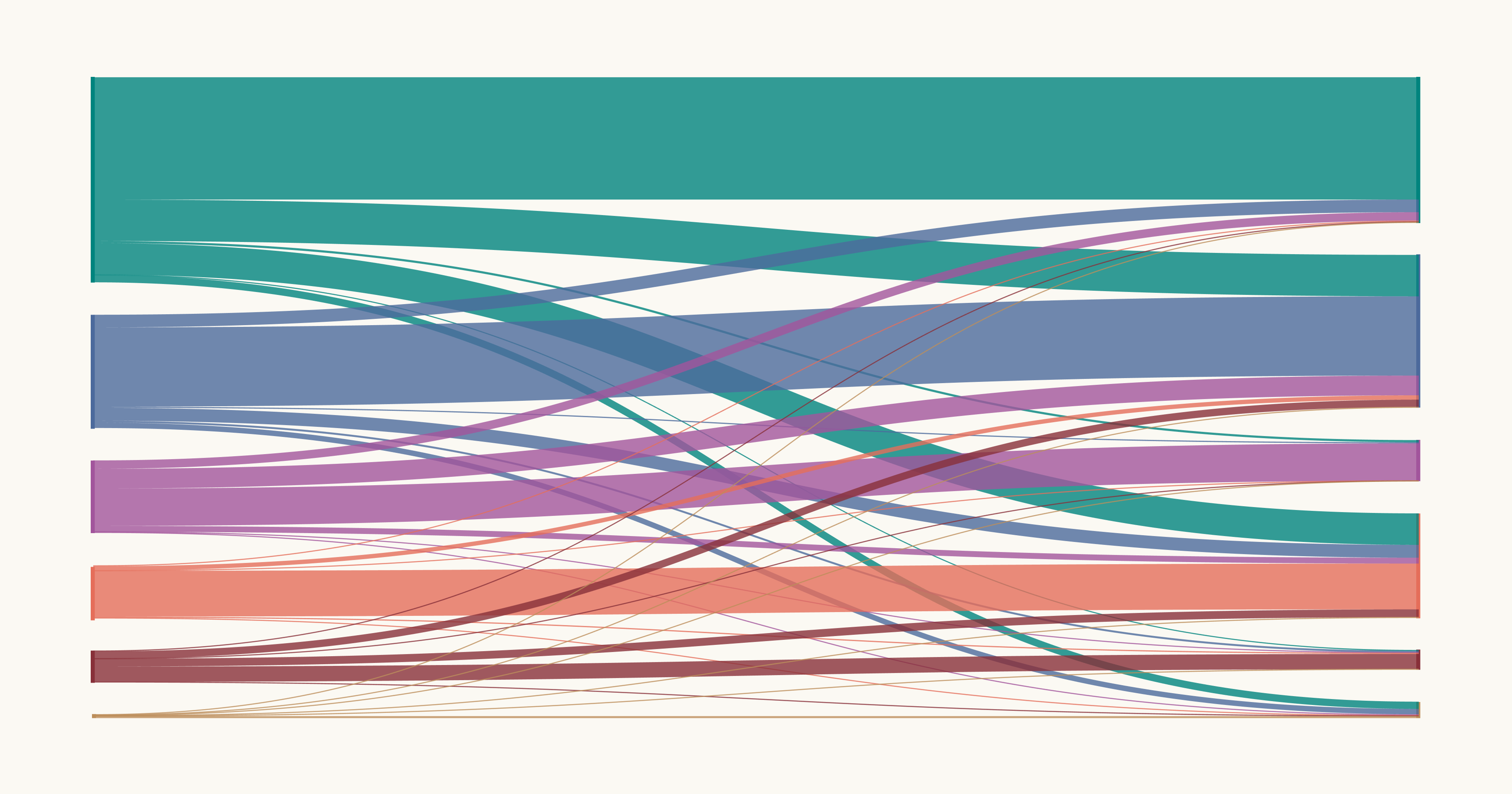
Where were these international migrants born, and where did they move to?
At Our World in Data, we built a graphing tool called the Grapher, designed to be flexible enough to visualize thousands of very different metrics. Unfortunately, it isn’t able to show flows between countries.
My colleague Sophia Mersmann has now built a specific interactive visualization that is optimized for this country-to-country data. It’s shown below.1
On the left-hand side, you can see the total number of people living in that country who were born elsewhere, and where they were born. On the right-hand side, you can see the number of people born in that country who have moved away, and where they moved to.
By default, you see the data for Malaysia, but you can select any country you are interested in.
A couple of additional options
If you want to dig in deeper, here are a few other ways you can explore the data:
- Look at the migrant data by sex to see where men or women are moving.
- Use the time slider to see how things have changed over time.
- Click on “immigrants” or “emigrants” to focus only on those views of the data, rather than migration in and out of a country.
Acknowledgments
Many thanks to Marcel Gerber for his help in building this interactive visualization.
Thanks also to Max Roser and Edouard Mathieu for their comments and suggestions on this article.
Migration
Migration has been an important source of economic development and poverty reduction. Explore data on global migration.
How do countries measure immigration, and how accurate is this data?
Countries estimate how many people move in and out using censuses, surveys, and border records. How accurate are these numbers, and can they account for illegal migration?
Most international migrants don’t move very far from their home countries
Long-distance moves are becoming more common, but they remain the exception. For most, international migration still means crossing a nearby border, not an ocean.
Endnotes
This data comes from the United Nations Department of Economic and Social Affairs (UN DESA). It shows the total number of people living in another country, which is not the flow of migrants each year. Unfortunately, UN DESA does not have this data in annual flows; otherwise, we would also show it.
Cite this work
Our articles and data visualizations rely on work from many different people and organizations. When citing this article, please also cite the underlying data sources. This article can be cited as:
Hannah Ritchie, Sophia Mersmann, Tuna Acisu, and Marwa Boukarim (2026) - “Where do migrants live, and where were they born?” Published online at OurWorldinData.org. Retrieved from: 'https://archive.ourworldindata.org/20260615-000126/where-do-migrants-live-and-where-were-they-born.html' [Online Resource] (archived on June 15, 2026).BibTeX citation
@article{owid-where-do-migrants-live-and-where-were-they-born,
    author = {Hannah Ritchie and Sophia Mersmann and Tuna Acisu and Marwa Boukarim},
    title = {Where do migrants live, and where were they born?},
    journal = {Our World in Data},
    year = {2026},
    note = {https://archive.ourworldindata.org/20260615-000126/where-do-migrants-live-and-where-were-they-born.html}
}
Reuse this work freely
All visualizations, data, and articles produced by Our World in Data are completely open access under the Creative Commons BY license. You have the permission to use, distribute, and reproduce these in any medium, provided the source and authors are credited.
The data produced by third parties and made available by Our World in Data is subject to the license terms from the original third-party authors. We will always indicate the original source of the data in our documentation, so you should always check the license of any such third-party data before use and redistribution.
All of our charts can be embedded in any site.