


Beef production in Brazil has been the largest driver of global deforestation in recent decades
Most beef production in Brazil is to meet domestic rather than international demand.
Since the turn of the century, an area of forest five times the size of my home country, the United Kingdom, has been cut down to free up land for farming.1
If we want to reduce — and ultimately end — deforestation, we need to know what’s causing it, and where.
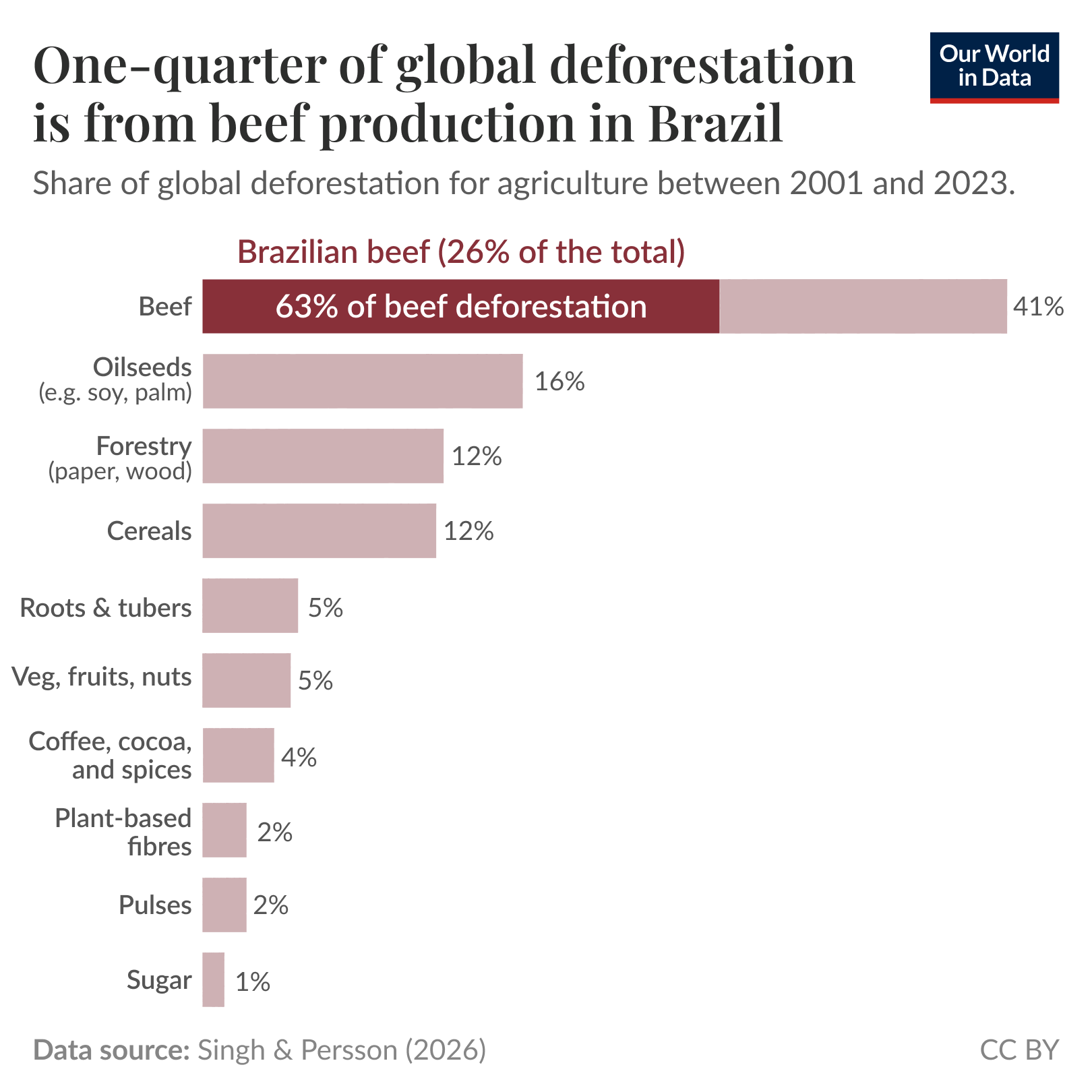
When we look at the largest drivers of this deforestation, beef production is the standout. The clearing of forests to make space for grazing pastures has driven 41% of global deforestation in recent decades.2
Where has this happened? Mostly in Brazil. Almost two-thirds of it has taken place there, as you can see in the chart below. That means one-quarter of global deforestation is caused by beef production in Brazil.
The expansion of cattle pastures has not just come at the expense of natural forests, but particularly of biodiverse regions in the Amazon rainforest and Cerrado savanna.
Since demand for beef is growing globally, one might think that a lot of this beef goes overseas. But this isn’t really true: most of the beef Brazil produces is consumed domestically.3
Beef consumption has grown a lot in Brazil, with per-person demand doubling over the past 50 years. Average consumption is now three times the European average.4
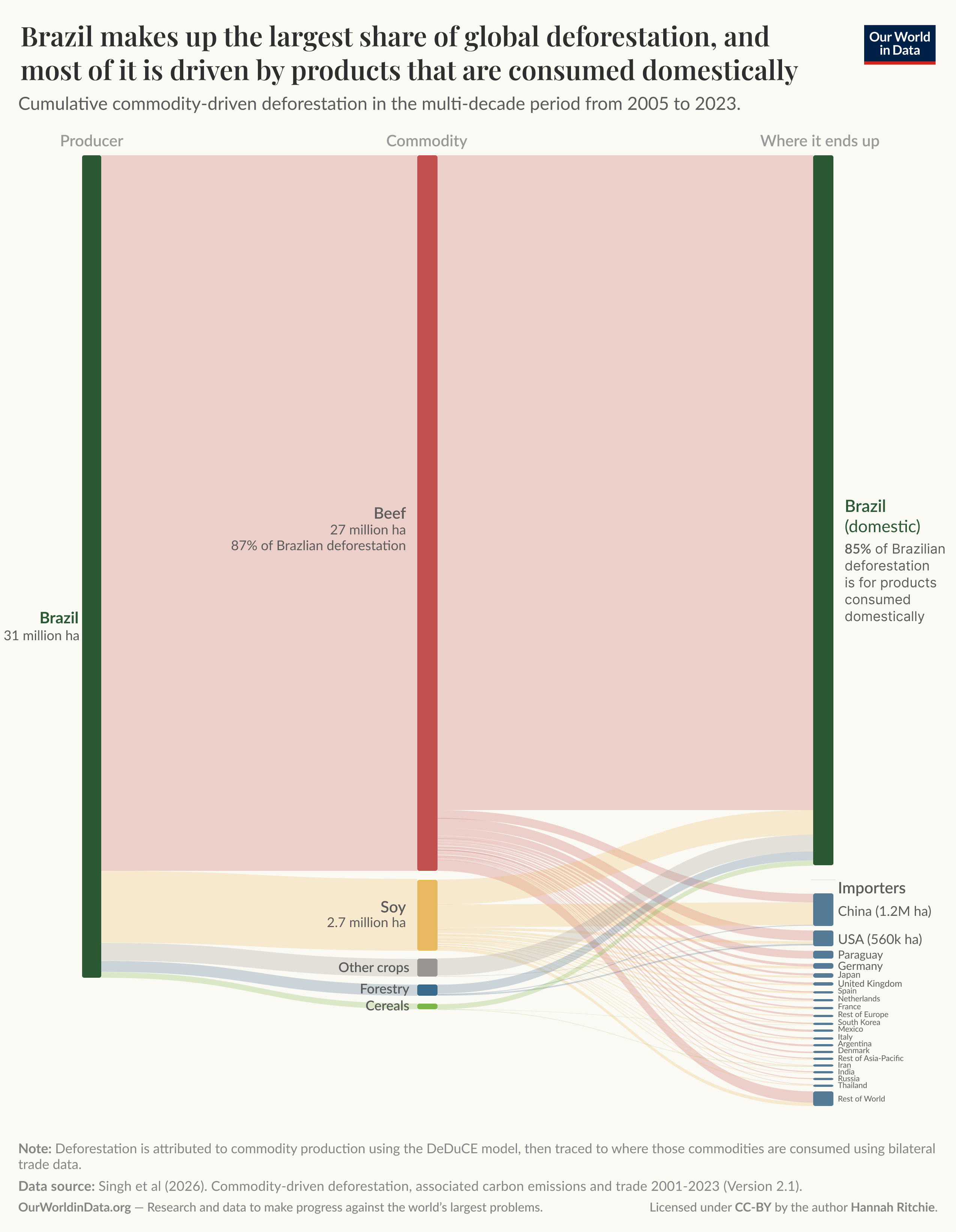
Estimates of “traded deforestation” confirm how much of this story is a domestic one.5 The chart below shows where the products that drive deforestation in Brazil end up. This data is for the period 2005 to 2023 (the only timeframe this trade-adjusted data is available), but you get similar results when looking only at the last few years.
An area of forest five times the size of the United Kingdom has been cut down to free up land for farming.
Again, you can see that beef production dominates.
Around 85% of deforestation in the country was driven by domestic demand. The other 15% was exported and spread across many countries — China and the United States are the largest importers, but none are particularly dominant.
International demand for beef (and soy) has driven some deforestation in Brazil, but most of it has been to meet demand at home.
Acknowledgments
Many thanks to Max Roser and Edouard Mathieu for their comments and suggestions on this article.

Global Food Data Explorer
Explore the world's food system, from production to supply.
Agricultural Production
How much, and what types of food, do countries produce across the world?
Do rich countries import deforestation from overseas?
Rich countries import foods produced on deforested land in the tropics. How much deforestation do they import?
Endnotes
Commodity-driven deforestation between 2001 and 2023 was estimated at 128 million hectares globally. This includes agricultural production and forest plantations.
The United Kingdom has a land area of around 24 million hectares. [128 million / 24 million = 5.3 times the size].
Singh, C., & Persson, U. M. (2026). Global patterns of commodity-driven deforestation and associated carbon emissions. Nature Food.
The country produces around 9–10 million tonnes of beef each year, of which around 3 million tonnes are exported.
In 2023, it was third in the global rankings, behind Argentina and Zimbabwe, which consume slightly more.
Singh, C., Persson, U. M., Croft, S., Kastner, T., & West, C. D. (2026). Commodity-driven deforestation, associated carbon emissions and trade 2001–2023 (Version 2.1) [Dataset]. Zenodo.
Cite this work
Our articles and data visualizations rely on work from many different people and organizations. When citing this article, please also cite the underlying data sources. This article can be cited as:
Hannah Ritchie (2026) - “Beef production in Brazil has been the largest driver of global deforestation in recent decades” Published online at OurWorldinData.org. Retrieved from: 'https://archive.ourworldindata.org/20260831-000132/beef-production-in-brazil-has-been-the-largest-driver-of-global-deforestation-in-recent-decades.html' [Online Resource] (archived on August 31, 2026).BibTeX citation
@article{owid-beef-production-in-brazil-has-been-the-largest-driver-of-global-deforestation-in-recent-decades,
    author = {Hannah Ritchie},
    title = {Beef production in Brazil has been the largest driver of global deforestation in recent decades},
    journal = {Our World in Data},
    year = {2026},
    note = {https://archive.ourworldindata.org/20260831-000132/beef-production-in-brazil-has-been-the-largest-driver-of-global-deforestation-in-recent-decades.html}
}
Reuse this work freely
All visualizations, data, and articles produced by Our World in Data are completely open access under the Creative Commons BY license. You have the permission to use, distribute, and reproduce these in any medium, provided the source and authors are credited.
The data produced by third parties and made available by Our World in Data is subject to the license terms from the original third-party authors. We will always indicate the original source of the data in our documentation, so you should always check the license of any such third-party data before use and redistribution.
All of our charts can be embedded in any site.