


No matter how you ask, more Americans are negative than positive about AI
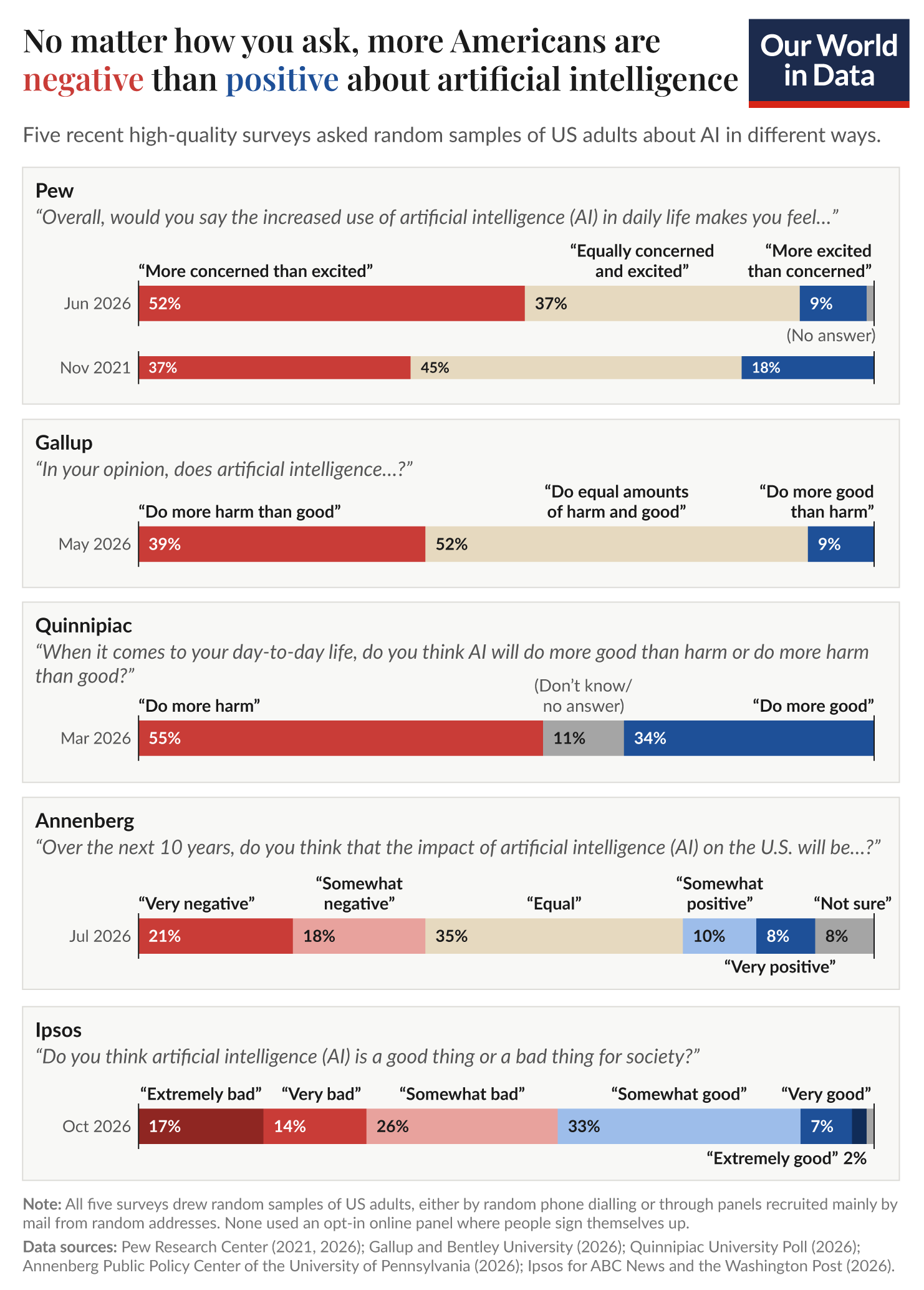
Five high-quality surveys ask about AI in different ways. Their wording matters, but the overall picture is consistent.
Online, the benefits and risks of artificial intelligence are intensely debated. Yet we all know that the online world is far from representative, and so I wanted to know what Americans more broadly think about it.
But when it comes to surveys, I tend to be cautious. What people report in a survey can shift quite substantially when a question is worded slightly differently or when respondents can choose their answer from different options.
So instead of just relying on one survey, I searched for a range of recent high-quality surveys and put them together in this chart.1
As you can see, the survey’s wording does matter. When a middle answer is offered, many people take it — 37% did in Pew’s recent survey, shown at the top — and a smaller share reports a positive view: in both Pew’s and Gallup’s surveys, only 9% chose it.
What surprised me is how consistent the overall result is. Every survey finds that more Americans have a negative view of AI than a positive one. In Pew’s survey, 52% say they are “more concerned than excited”, and 9% are “more excited than concerned” — a ratio of more than five to one. When Pew first asked this in 2021, the ratio was about two to one.
Few Americans are enthusiastic about AI. When people have strong feelings, they are mostly negative. In the Ipsos survey, 17% said AI is an “extremely bad” thing for society, and just 2% said “extremely good”.2
People’s worries extend to the most extreme risks. In a Quinnipiac poll in September 2026, Americans were asked: “How concerned are you that future AI systems could potentially threaten human survival?” 35% said they are somewhat concerned and 38% said they are very concerned. Most Americans (73%) believe there is a risk that AI could threaten the survival of humanity.3
And concern about AI is not confined to one party. In Pew’s survey, 56% of Democrats and 49% of Republicans are more concerned than excited about AI. And in both parties, only around one in ten are more excited than concerned.
There is no question that many find the prospects of AI exciting. But what this data shows is that for more Americans, the concerns are larger. If the industry wants to earn the public’s trust, it will have to take these widespread concerns much more seriously than it has so far.

Artificial Intelligence
AI already has a large impact on our world. Explore research and data to understand the trajectory of this important technology.

Technology over the long run: zoom out to see how dramatically the world can change within a lifetime
It is easy to underestimate the magnitude of this change. Understanding this can help us see how different the world could be in the future.

US and Chinese companies train almost all of the world’s most-used AI models
Endnotes
I only included surveys based on probability samples. Quinnipiac called randomly generated landline and cell phone numbers. The other four surveyed members of online panels that were themselves recruited at random, mostly by mail to randomly selected addresses: Pew’s American Trends Panel, the Gallup Panel, the panel used by the Annenberg Public Policy Center, and Ipsos’s KnowledgePanel. All five surveys weight their results to match the US adult population, and publish the full wording of their questions and their results.
I did not include any of the many polls based on opt-in online panels, which anyone can sign up to. This method can obviously lead to very biased results (an appalling example is an opt-in poll that found that 20% of Americans under 30 agreed that “the Holocaust is a myth” — when Pew asked the same question on its probability-based panel it found 3%).
In 2021, Pew introduced the question with a short definition and referred to “artificial intelligence computer programs” rather than “artificial intelligence (AI)”: “Artificial intelligence computer programs are designed to learn tasks that humans typically do, for instance recognizing speech or pictures. Overall, would you say the increased use of artificial intelligence computer programs in daily life makes you feel…” The answer options were the same, and Pew reports the results as one trend.
These are the surveys I included:
Pew Research Center: Monica Anderson and William Bishop (2026). Democrats are now more worried than Republicans about AI and its impact on jobs. Published September 16, 2026. Based on a survey of 3,488 US adults on the American Trends Panel, conducted June 22–28, 2026; the November 2021 data is from a survey on the same panel conducted November 1–7, 2021. See the full topline results.
Gallup and Bentley University (2026). Bentley-Gallup Business in Society Survey: 2026 Report. Based on a web survey of 3,270 US adults on the Gallup Panel, conducted May 4–11, 2026. See the full report.
Quinnipiac University Poll (2026). The age of artificial intelligence: Americans’ AI use increases while views on it sour. Released March 30, 2026. Based on a telephone survey of 1,397 US adults, conducted March 19–23, 2026. See the full poll results.
Annenberg Public Policy Center of the University of Pennsylvania (2026). Artificial Intelligence — Topline Report, APPC W38 National Survey. Based on a probability-based online panel survey of 1,320 US adults, conducted June 16–July 19, 2026. See the topline report.
Ipsos (2026) for ABC News and The Washington Post. Based on a survey of 2,545 US adults on the Ipsos KnowledgePanel, conducted October 9–13, 2026. See the topline results.
The survey question on which Americans are not more negative than positive asked about AI’s effect on them personally. In the same Ipsos survey, 50% said AI is a good thing “for you personally” and 49% a bad thing. (But even here, strong feelings were mostly negative: 15% said AI is extremely bad for them personally, against 3% who said extremely good. And other questions about people’s own lives find more negative views: in Quinnipiac’s March 2026 poll, 55% expected AI to do more harm than good in their day-to-day life, against 34% who expected more good.)
This is based on a telephone survey of 1,202 US adults, conducted September 24–27, 2026 using random digit dialing, with live interviewers calling landlines and cell phones. The full question was: “How concerned are you that future AI systems could potentially threaten human survival: very concerned, somewhat concerned, not so concerned, or not concerned at all?” Very concerned: 38%; somewhat concerned: 35%; not so concerned: 14%; not concerned at all: 11%; don’t know or no answer: 1%.
Quinnipiac University Poll (2026). The Age Of Artificial Intelligence: 73% Concerned About Potential Threat To Human Survival, Quinnipiac University Poll On AI Finds; 86% Support Independent Safety Standards For AI Companies. Released September 30, 2026. See the full poll release.
Cite this work
Our articles and data visualizations rely on work from many different people and organizations. When citing this article, please also cite the underlying data sources. This article can be cited as:
Max Roser (2026) - “No matter how you ask, more Americans are negative than positive about AI” Published online at OurWorldinData.org. Retrieved from: 'https://archive.ourworldindata.org/20261116-000041/no-matter-how-you-ask-more-americans-are-negative-than-positive-about-ai.html' [Online Resource] (archived on November 16, 2026).BibTeX citation
@article{owid-no-matter-how-you-ask-more-americans-are-negative-than-positive-about-ai,
    author = {Max Roser},
    title = {No matter how you ask, more Americans are negative than positive about AI},
    journal = {Our World in Data},
    year = {2026},
    note = {https://archive.ourworldindata.org/20261116-000041/no-matter-how-you-ask-more-americans-are-negative-than-positive-about-ai.html}
}
Past versions
We are a live site and we keep our work maintained. So our articles are often changed, including the data. You can browse previous versions of this work here.

Reuse this work freely
All visualizations, data, and articles produced by Our World in Data are completely open access under the Creative Commons BY license. You have the permission to use, distribute, and reproduce these in any medium, provided the source and authors are credited.
The data produced by third parties and made available by Our World in Data is subject to the license terms from the original third-party authors. We will always indicate the original source of the data in our documentation, so you should always check the license of any such third-party data before use and redistribution.
All of our charts can be embedded in any site.